
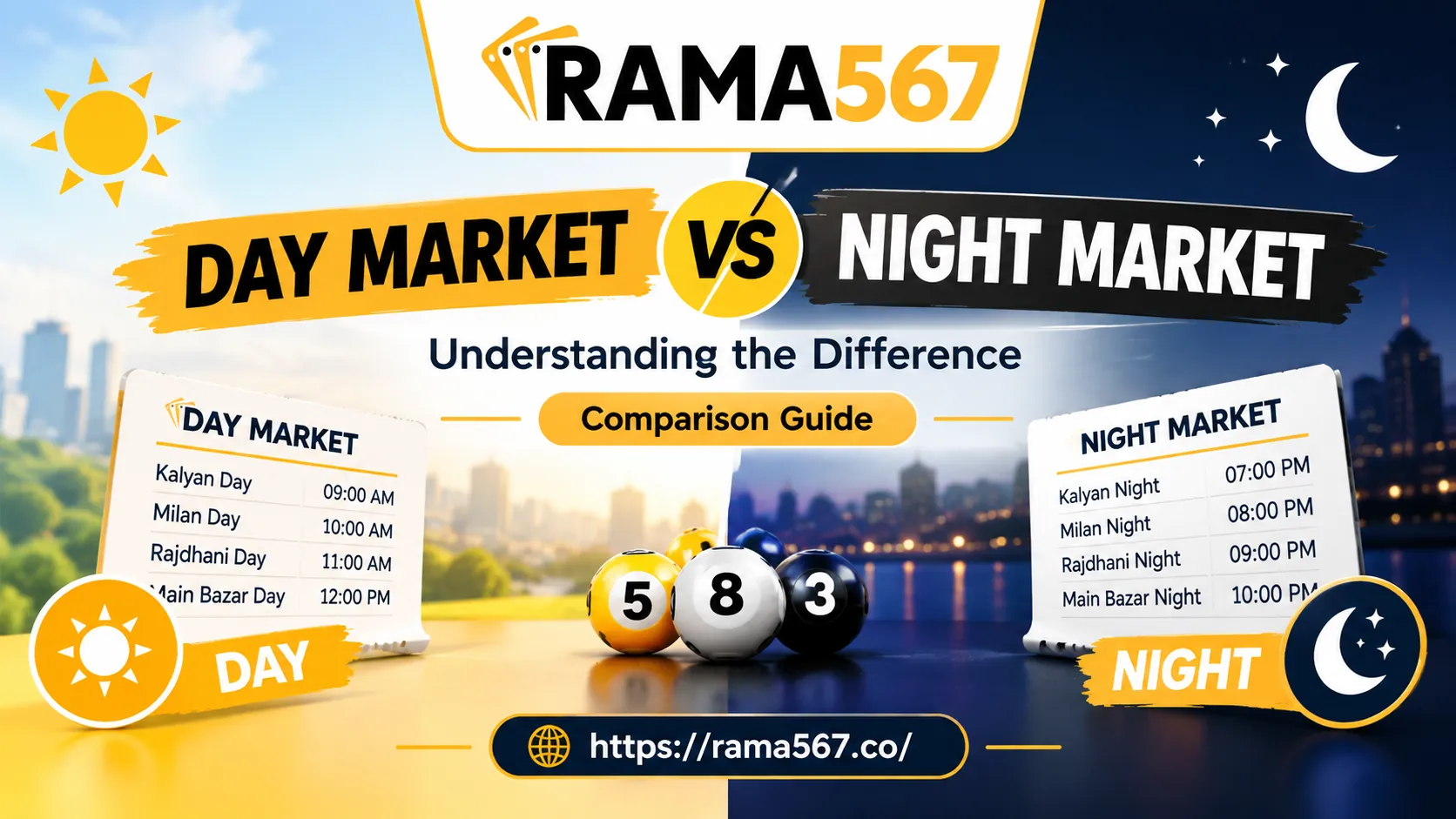
While browsing the Matka platforms, you'll typically encounter phrases such as "Day Market," "Night Market," "Open," and "Close." If you're a beginner, understanding these terms can be difficult, particularly when two markets have nearly identical names, despite their timing designation.
Understanding the way these markets function is easy after you have a clear understanding of the structures and their timings. The following comparison guide will explain the fundamental differences between the day and market at night, and how their timings are determined, as well as the best way to interpret market data in a clear and precise manner without any confusion.
1. What Is a Day Market?
A day market is the market that is open and ends during the daylight hours. They typically run all day long, beginning in the morning and ending the late afternoon and offer an array of results prior to the time that evening comes in.
It is important to note that the "Day" designation in a market's name refers to its operating time. But, the timing of results can differ significantly among different markets during the day. The market for the day might announce results before midday, whereas another market will release results by the afternoon.
Since operating hours are determined in a different way by every market You should ensure the specific schedules of markets rather than believing that all markets operate on exactly the same schedule.
2. What Is a Night Market?
The night market is open throughout the night and evening time. The schedules typically begin with the afternoon hours or in the early evening, and end late at night, or after midnight.
Market operators use "Night" designation to signal that their operating hours are beyond normal operating hours. Like day markets, market nights do not operate on an unison schedule. Their opening and closing hours are different depending on the market's entity.
Having the exact times listed of any market at night makes sure you're on the right schedule for this particular segment.
3. Day Market vs Night Market: Main Differences
| Factor | Day Market | Night Market |
|---|---|---|
| General Operating Period | The daytime hours (Morning through afternoon) | The evening and night hours |
| Market Naming | Often includes "Day" (e.g., Milan Day) | Often includes "Night" (e.g., Milan Night) |
| Result Timing | Based on the particular market timetable | Based on the particular market timetable |
| Result Records | Charts of historical day accessible | Night charts from the past accessible |
| Market Schedule | Market-specific timetables | Market-specific timetables |
| Core Distinction | Timing of operation | Timing of operation |
4. Timing Is the Main Difference
The primary distinction between a market that is a day or a night market is the time period during which they operate. The basic rules, structure and language are generally the same across all types of markets.
It's crucial to note the fact that market names identical to each other with distinct timetags--such for "Day" or "Night"--are treated as distinct markets. The outcome of the daytime market does not have any connection to its nighttime counterpart because each operates on an independent timetable.
5. Day and Night Markets on Rama567
Platforms that provide market data often provide a variety of nighttime and daytime alternatives side-by-side. With the Rama567 the users are able to browse data across a range of popular calendars.
The most common examples of markets that are paired are:
- Milan Day and Milan Night
- Rajdhani Day and Rajdhani Night
The pairings let users see different schedules based on the hour of the day. It is possible to explore other marketing and educational information through our guide for the Rama567.
6. Understanding Open and Close Results
When a market runs in the evening or daytime the results are usually announced by two distinct phases which are Opening and closing.
- open: refers to the first number or outcomes declared after the market cycle starts.
- End: Refers to the last set of numbers announced at the close of the market's operating period.
The interval between Open and Close results is dependent on the specific market's schedule. For a better understanding of how these formats work check out our detailed explanation of the way Matka functions.
7. Day Market vs Night Market Results
The records of historical results are arranged according to market name, date and time segment. If you look through archives of results every record usually displays:
- Datum: The calendar day when the market was operating.
- Market Name This is the market's specific name with the Day or Night name.
- Open Results: The opening number is set.
- Close Result The closing number is set.
As night and day markets are two distinct entities their results are recorded in different databases. Historical records can be viewed as well as view Matka charts and other historical documents to find out how previous archives were formatted to accommodate the night-time market as well as day-time.
8. Why Market Names Can Be Confusing
The new readers are often confused with markets due to the fact that a variety of popular names are available in both daytime and nighttime variants. In particular, Milan Day and Milan Night are totally distinct markets, with different outcomes, even though they share the name "Milan."
This is the same for Rajdhani Day and Rajdhani Night. It is important to note that the "Day" and "Night" tags are crucial identifiers. Double-check for the complete title to prevent getting information that is intended for a different period of operation.
9. How to Read Day and Night Market Information
To interpret the market's information correctly to interpret market data, use this simple steps-by-step guideline:
- Determine the exact market name (confirm that it is "Day" or "Night").
- Review the calendar to determine what time the market is open and closes.
- Check the results type (determine whether you're seeing either the Open or Close figures).
- Examine the date that is associated with the file to make sure the record is up-to-date.
- Historical charts that cross-reference exclusively within the matching market category.
- Trust in verified market news to get accurate timing data.
10. Day vs Night Matka: Key Takeaways
- Operating hours determine the class: The primary difference between markets that operate during the day and at night is the time they operate.
- The schedules differ for each market: Different markets during the day do not have the same time as night markets, the same holds applicable to night markets.
- Both night and day variants of the same name are totally separate markets.
- Two-stage outcomes: Both categories generally release results for Close and Open in their specific times.
- Historic records aren't able to provide predictions for future events: Past result charts are strictly used as documentation for historical purposes.
11. Responsible and Legal Information
Matka is a form of gambling that involves money that is a risk in itself. The laws and regulations that govern traditional and online gaming vary greatly by location and. Gamblers should ensure that they are in compliance with all local laws on online gaming.
Charts, historical archives analysis and graphs are strictly data-driven. The historical records, trends analysis, or guessing strategy will guarantee the future outcome. Anyone who accesses information from Rama567 should be 18 years old or legally able to do so within their respective jurisdiction. They are encouraged to take personal accountability.
Conclusion
The main difference between a morning market and one that is night is due to the time and timing. The structural frameworks of both markets such as Open and Close market results are nearly the same, they are conducted at different times during the day, and have separate historic records.
Be sure to verify the market's exact name, date, and hours of operation when looking up information on the internet. Platforms such as Rama567 offer structured information on markets for readers to make it easier to distinguish between nighttime and daytime times.
Frequently Asked Questions (FAQs)
1. What is the difference between a Day Market and a Night Market?
The main difference is the operating time. A Day Market generally operates during daytime hours, while a Night Market operates during evening or nighttime hours. Exact schedules can vary by market.
2. Are Day and Night Matka markets the same?
No. A Day Market and Night Market with similar names are treated as separate markets. For example, Milan Day and Milan Night have different schedules and separate result records.
3. Do Day and Night markets have different result timings?
Yes. Each market follows its own timetable. The result timing depends on the specific market rather than simply whether it is classified as a Day or Night Market.
4. Where can I check previous Day and Night Matka results?
Previous results are generally organized in historical records or charts according to the market name, date, and result type. Always check that the record belongs to the correct Day or Night market before using it for reference.
5. Are Milan Day and Milan Night different markets?
Yes. Although they share the name Milan, the Day and Night versions are separate market categories with their own schedules and historical records.
6. What is the difference between Open and Close results?
Open results refer to the result announced at the opening stage of a market cycle, while Close results refer to the result associated with the closing stage. The exact format and timing can vary between markets.
7. Can historical Matka results predict future results?
No. Historical results and charts are records of past events. They should not be considered a reliable method for predicting future outcomes or guaranteeing any particular result.
8. Why should I check the complete market name?
Checking the complete market name helps prevent confusion between similarly named Day and Night markets. Always verify the market name, date, and applicable schedule when reviewing historical records.