
If a colleague in London sends a spreadsheet with the number 1,250, they are referring to one thousand two hundred and fifty.
If a financial auditor in Berlin or Paris opens the exact same file without locale adjustments, their software may interpret 1,250 as one point two five zero—a number that is one thousand times smaller.
Across the internet, data tables, financial reports, and statistical ledgers routinely exchange figures across geographic boundaries. Yet few conventions cause as much silent, destructive computational confusion as the humble comma (,) and period (.).
The Global Divide: Point vs. Comma Conventions
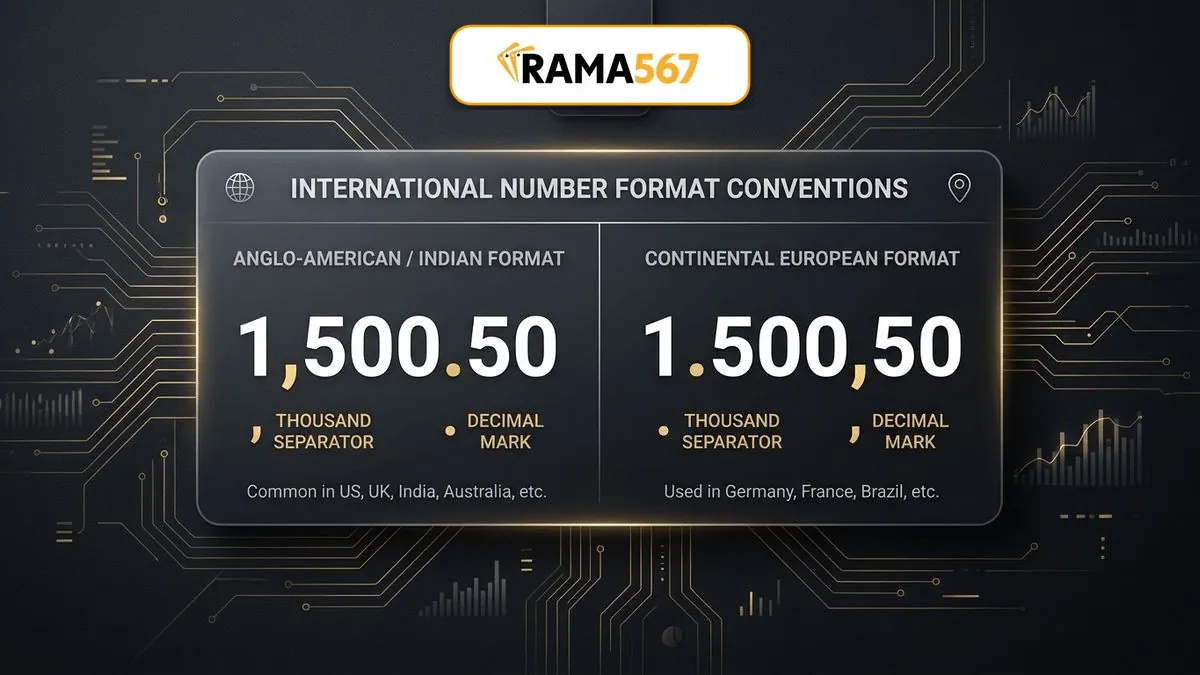
Around the world, numerical punctuation is divided into two primary camps:
┌────────────────────────────────────────────────────────┐
│ ANGLO-AMERICAN / INDIAN STANDARD:                      │
│   1,234,567.89                                         │
│   └── Comma (,) = Thousands separator                  │
│             └── Dot (.) = Decimal point                │
├────────────────────────────────────────────────────────┤
│ CONTINENTAL EUROPEAN / SOUTH AMERICAN STANDARD:        │
│   1.234.567,89                                         │
│   └── Dot (.) = Thousands separator                    │
│             └── Comma (,) = Decimal point              │
└────────────────────────────────────────────────────────┘
1. Decimal Point (Dot as Decimal)
Used in India, the United States, the United Kingdom, Canada, Australia, Japan, and China. Here, whole numbers are separated from fractional quantities by a full stop (.), while thousands are partitioned by commas (,).
2. Decimal Comma (Comma as Decimal)
Used across Continental Europe (Germany, France, Spain, Italy, Scandinavia), Russia, and much of South America (Brazil, Argentina). In these jurisdictions, the comma marks fractional parts, and periods or non-breaking spaces group thousands.
Why Neither Convention is "Wrong"
Both systems emerged from centuries of typographic and mathematical tradition. In 17th-century Scotland and England, John Napier popularized the period for decimal fractions in logarithmic tables. Meanwhile, Continental European typographers favored the comma to prevent small periods from being obscured by ink blurs in letterpress printing.
The Unique Beauty of the Indian Numbering System
For readers analyzing datasets in India or on Indian platforms, there is a third dimension: the grouping structure of digits.
Under standard international Western formatting, digits are partitioned in strict sets of three: $\text{Western Format: } 10,000,000 \quad (\text{Ten Million})$
Under the Indian numeral system, recognized across Indian statutory bodies and commercial reporting, digits are partitioned after the initial three by twos:
$\text{Indian Format: } 1,00,00,000 \quad (\text{One Crore})$ $\text{Indian Format: } 12,34,567 \quad (\text{Twelve Lakh Thirty-Four Thousand Five Hundred Sixty-Seven})$
| Numeric Value | Western Format | Western Term | Indian Format | Indian Term |
|---|---|---|---|---|
| 100,000 | 100,000 | One hundred thousand | 1,00,000 | One Lakh |
| 1,000,000 | 1,000,000 | One million | 10,00,000 | Ten Lakh |
| 10,000,000 | 10,000,000 | Ten million | 1,00,00,000 | One Crore |
| 1,000,000,000 | 1,000,000,000 | One billion | 100,00,00,000 | One Hundred Crore (or Arab) |
When global software systems blindly parse Indian financial sheets without configuring the en-IN locale, automated regex parsers often fail because they expect three digits between every comma.
How Transposition Errors Break Software and Datasets
When datasets move between servers or are imported into tools like Microsoft Excel, Python Pandas, or SQL databases, format collisions create real-world havoc:
- The 1000× Scale Error:
If an automated scraper extracts the European price€12,50(twelve euros fifty cents) and parses it using an English locale where commas are ignored as thousands separators, the system stores1250—turning a €12 lunch into a €1,250 expense. - The Truncation Error:
Conversely, if an English integer1,500is parsed by a European script expecting a decimal comma, the software reads1.5and discards the two trailing zeros as insignificant decimal digits. - CSV String Collisions:
In Comma-Separated Values (.csv) files, commas delimit columns. If a table cell contains1,500without enclosing quotation marks, the CSV parser splits the single value into two separate columns: column A receives1and column B receives500. To resolve this, European countries frequently use semicolon-delimited CSVs (.csvfiles with;separators).
Observing Number Formats on Rama567
On Rama567, transparent data presentation requires explicit adherence to regional formatting norms.
In our repository and architecture audit:
- Historical panel records on the charts archive present three-digit panna combinations (e.g.,
128,359,670) and two-digit jodi pairs (e.g.,45,82). Because these represent discrete numerical tokens rather than continuous decimal measures, commas and periods are intentionally omitted to prevent misinterpreting an identifier as a fractional value. - Educational guides and policy pages follow the standard Indian English formatting conventions (
en-IN), using periods for decimals and adhering to Indian digit grouping conventions where statistical volumes or player counts are discussed.
The Modern Solution: ISO 80000-1 Thin Spaces
To eliminate cross-border confusion entirely, the International Organization for Standardization (ISO) and the Bureau International des Poids et Mesures (BIPM) established the ISO 80000-1 guideline:
The Universal Standard:
Use a thin, non-breaking space (UnicodeU+202For ) as the thousands separator, and never use a comma or a period to group digits.
$\text{Universal Standard: } 1\thinspace500.50 \quad \text{or} \quad 1\thinspace500,50$
Under this rule, because spaces can never be mistaken for decimal markers, the reader immediately recognizes whether a period or comma is being used for fractions.
A Reader’s Guide to Checking Online Table Notation
Before drawing conclusions from an unfamiliar online data table, take three verification steps:
- Check the Origin Header: Look for the publisher's locale code (e.g.,
en-US,de-DE,en-INin the HTML tag or document footer). - Scan for Obvious Whole-Number Benchmarks: Look at rows with known integers (such as population counts or item quantities). If you see
1.000people, the period is a thousands separator. - Verify the CSV Delimiter: When downloading open datasets, inspect whether the columns are delimited by commas, semicolons, or tabs before running automated calculations.
Continue exploring our technical data literacy series on the Rama567 Blog to build a sophisticated understanding of how online records, data provenance, and numerical tables work in practice.