
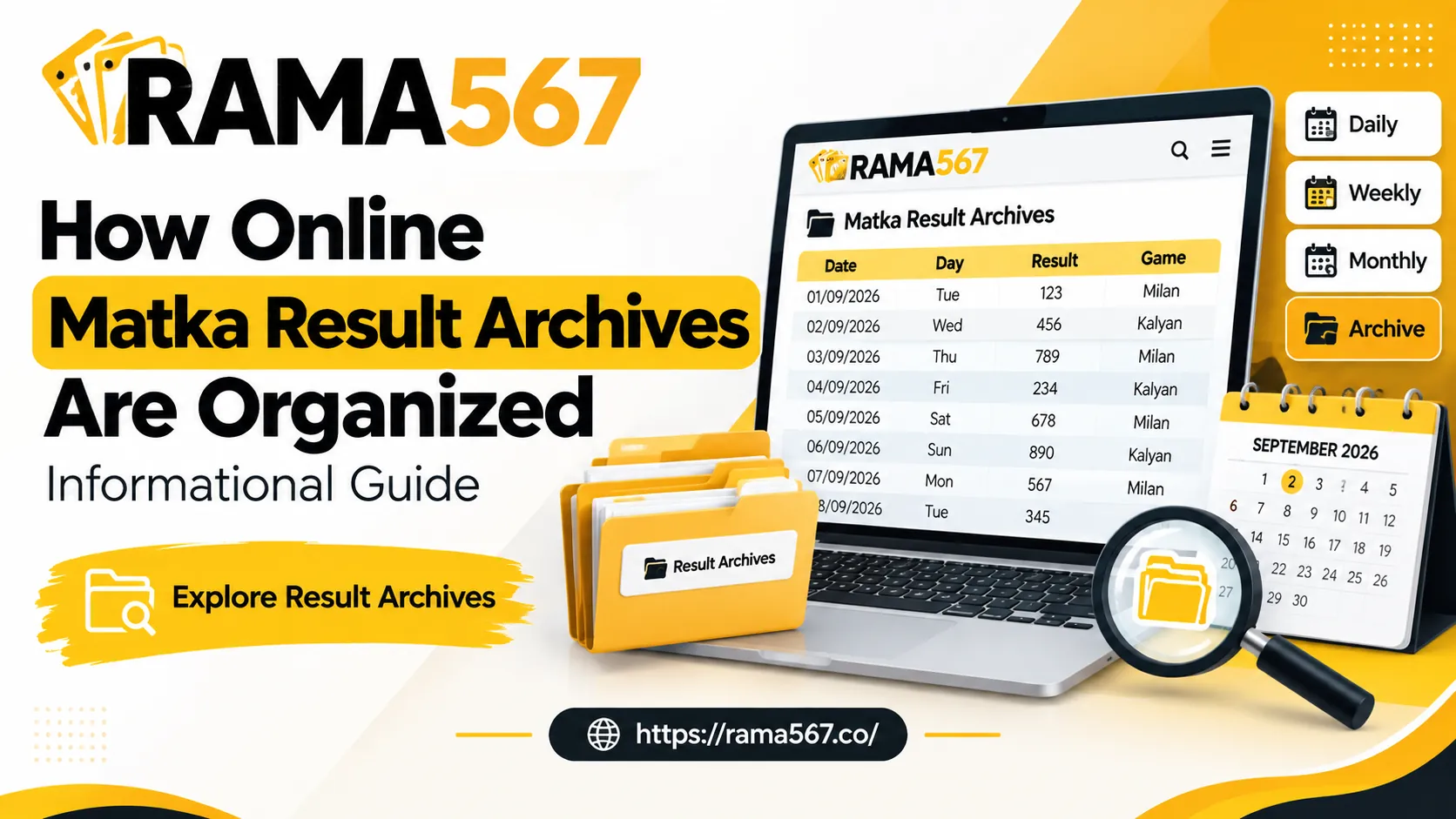
Navigating digital information hubs requires structure. In the case of checking for updates in real time via platforms such as rama-567.com the users are presented with instant, live updates. But, when an event is finished, the numbers don't disappear. They are transformed to a centralized repository, referred to as an online archive of results.
The way these historic result records are arranged makes locating the previous entries simple. When you're trying to find details from the past month, or a long time back, understanding how digital archives categorize the index and current the data will ensure efficient search.
This document explains the ways online archives organize their old records, how you can understand archive tables with no confusion, and how to handle the absence of data and to handle historical logs in a responsible manner.
What Is a Matka Result Archive?
A web-based Matka results archive can be described as a central, digital database which stores previously published results arranged in accordance with date, price, and date.
Key Characteristics of an Archive
- Static Data Reference: As opposed to live feeds, which update continuously in draw windows Archived records are documents that have been preserved as static as historical references.
- Chronological Indexing: Data is systematically stored by exact date of calendar as well as years, months and weeks.
- Categorized Libraries: Information is divided into separate directories for market-related information such as Kalyan, Milan, Rajdhani or Time Bazar to avoid market confusion.
- Archive Access for Historical Information: Archives permit users to check out past entries without blocking active daily boards.
Why Are Online Result Archives Organized by Date?
The primary method for organizing data is based on dates. technique used by websites for structuring historical records. The chronological structure of information has several advantages.
- Removes the burden of information: Grouping hundreds of entries from the past by particular dates eliminates scrolling.
- Allows Direct Access: Users looking for specific dates (e.g. 24, August 24 20, 2026) will be able to skip irrelevant information and go directly to that day's date entry.
- Sets the Context Provides: Context an unambiguous timeline that reveals precisely when an item was finalized and published.
- Reduces the chance of confusion: The strict date labels ensure that older documents aren't mistaken for actual updated information.
Common Ways Online Matka Archives Are Organized
Platforms use different layouts in accordance with how much information from the past is shown in a single webpage. Common formats include:
1. Date-Wise Archives
Daily archives are a 24 hour log. Each entry made during the certain calendar day is displayed with system timestamps, market tags and tags.
2. Week-Wise Archives (Panel & Jodi Charts)
Weekly archives collect seven days of information (typically Monday to Sunday) into grid tables that are horizontal. Instead of pages that are separate, the header of a week (e.g. 24/08/2026 to 30/08/2026) is a way to group daily entries into one row.
3. Month-Wise & Year-Wise Summaries
To conduct long-term studies The monthly and yearly pages combine multiple week blocks into large directories. This allows users to look through wide time frames across one display.
4. Market-Specific Categories
Archive archives are separated with market boards. Anyone who is interested in Kalyan chart data from the past can go straight to the Kalyan directory, without having to look up information from Rajdhani or Milan Night.
How to Navigate an Online Result Archive
The process of finding a specific information on a website such as rama-567.com has a step-by-step procedure:
1.Open the Archive Section. Locate directories.
Go to the menu, or the footer, and then click on sections labelled the Result history, Jodi Charts, or Panel Charts.
2.Select the Market Category: To isolate specific boards.
Pick the appropriate market (e.g., Kalyan, Milan Day, Time Bazar) for loading its own historical database.
3.Set Date or Timeframe Parameters. Filter according to timeframe or date.
Utilize Dropdown menus and calendar widgets or selectors for week-ranges to define the precise month either year or week period.
4.Locate this Specific Record Row: Identify the entry to be targeted.
Check the rows of the table to be in sync with your desired date. the row or column cell.
5.Review the Displayed Information: Verify the details.
Review the archived numbers panels, figures and headings for categories carefully.
6.Cross-Check to Verify: Ensure your accuracy.
Check that the heading of the page, the category label and dates match the search query before you refer to the data.
Understanding Tables Used in Result Archives
Archive tables show small numerical data that is arranged in columns and rows. Knowing how cells in tables are organized prevents confusion when reading information.
Here is an example of illustrative general example of the way an archived weekly table should be structured:
| Week Range | Mon | Tue | Wed | Thu | Fri | Sat | Sun | Record Status |
|---|---|---|---|---|---|---|---|---|
| 17/08/2026 - 23/08/2026 | 278-78 | 170-69 | 234-35 | 689-28 | 168-45 | 600-60 | *- | Archived |
| 24/08/2026 - 30/08/2026 | 470-79 | 247-90 | 568-45 | 247-80 | 168-45 | *- | 600-60 | Archived |
| 31/08/2026 - 06/09/2026 | 190-49 | 579-67 | 899-99 | *- | *- | *- | *- | Active Week |
It is important to note that the table below is only an illustration and acts as an example for a structural general.
How to Read the Table
- Week Range: Column defines the seven-day time period included in that particular horizontal row.
- Days Columns (Mon-Sun): The map below shows the individual daily entries with their respective date in the course of the week.
- Cell Formatting: Includes the figures published (e.g., Open Pana, Jodi, Close Pana).
- Asterisks : indicate non-operational days and pending draws. They also indicate days when no record is available.
Difference Between Current Results and Archived Results
Confusion of active updates and previous entries is a frequent problem with navigation. This table outlines most important differences
| Feature | Current / Recent Information | Archived Information |
|---|---|---|
| Primary Focus | Real-time releases and live update | Records from the past that are historical |
| Location | Main homepages, live dashboards | Charts, charts and dedicated history pages archives |
| Update Frequency | Dynamically refreshes during draw times. | Static. Rarely changes after the finalization is made |
| Primary Purpose | Checking the current draw situation | Examining logs from the past and referencing records |
| Time Orientation | Present day / active draw window | Days and weeks, months or even years |
How to Find Older Result Records
If you are looking to find the historical documents from previous months or even years, you can use these navigation strategies that you are used to:
- Utilize Calendar Date Pickers: Use the interactive calendar tool to directly jump to specific days or months. You can also jump to the year.
- Explore Archive Links: Find the footer or sidebar links that are labeled monthly Archives and Old History or Panel Charts.
- Make use of Page Pagination: Move to the back of archive pages that are numbered (e.g. Page 1, Page 2 or Page 2 3) to look through earlier entries.
- Use Website Search: To type market names, dates and dates into the search bar of your internal browser as they become a search bar.
How to Check the Accuracy of Archived Information
If you are looking through archived data online, make sure you follow these guidelines:
- Check the Header of the Page: Check that the page's title this page corresponds to the market and timeframe you want to look at.
- Verify that the Calendar Date: Double-check the row headers or dates to ensure that you are not reading data with the incorrect date or year.
- Check for official Timestamps: Make sure you check the publication tags on the end of the table.
- Do not use unverified screen shots: rely on real-time, searchable internet databases such as rama-567.com instead of cropping photos from social media that do not have verified URLs to the source.
What If an Archive Record Is Missing?
Infrequently, blank rows in the table may occur due to various technological or operational reasons.
- Day of Non-Operation: Market boards shut on official holidays, or Sundays. The result is blank markers.
- The Platforms for: Database Maintenance periodically change servers or move old files, which can cause occasional gaps in archives.
- Incomplete Historical Depth: Platforms may keep archives only up to a specific date.
- Errors in Selection: If you choose a date that is prior to the date of its inception for a market is not going to yield any information.
If the record you want is not available be wary of assuming or creating the absence of numbers. The missing entries are simply a reflection of the absence of draw days or timeframes that are not archived.
Common Mistakes When Reading Online Result Archives
- Confusion of Old Records with Live Releases: A table from the past as if it was a live release, and then interpreting the old figures as actual results.
- Not paying attention to week-range headings: reading the cell and not confirming whether the row is for 2025 entries or entries from 2026.
- Readjustment across Wrong Columns: Misaligning horizontal rows of broad grid charts as well as the entry of Tuesday's under Wednesday's column.
- The assumption that incomplete archives are errors: The assumption that a record is missing is a sign of an event that was not recorded and not a planned holiday.
- Making use of Archives to help predict future outcomes: The belief that studying archive records from the past can help one predict the future.
Historical Result Archives Are for Reference, Not Prediction
One important concept for all readers to comprehend is that historic result archives serve as a reference document.
Although digital archives collect millions of old entries into clear, searchable tables, historical data is used to document what happened during the past. The historical records have no predictability, they don't affect the future random draw, and shouldn't be used as tools for forecasting or guarantees for future outcomes.
Conclusion
The online Matka result archives convert a vast collection of data from the past into tidy, well-organized digital libraries. Through categorizing entries according to market, arranging records by date with clearly laid-out grid tables, platforms such as rama-567.com help to find historical data effortlessly and easily.
If you are browsing archives ensure that headers are checked and examine date stamps with care as well as treat old records as resources for reference.
Frequently Asked Questions (FAQs)
1. What exactly is an online Matka results archive?
A web-based Matka results archive can be described as a computerized database which stores, assembles the results previously published, that are indexed according to date, price and time to provide the purpose of historical references.
2. What are the historical Matka results structured on the internet?
The historical results are arranged chronologically in daily journal entries, weekly panels, diagrams, summaries of the month and directories based on markets (such as Kalyan and Milan).
3. Where can I locate old results?
There are records from earlier times using the history section or chart section. There you can use calendar dates and pickers, as well as the week's range, or searching directories for the month.
4. What's the distinction between the current and archived results?
Results for today display live and real-time updates of today's draws. Results archived are finalized, static historical results that are stored to be used for future reference.
5. Are archives of past results able to predict the future?
No. Historical result archives document past published data only. They are reference records that remain static with no predictive power or effect on outcomes in the future.