
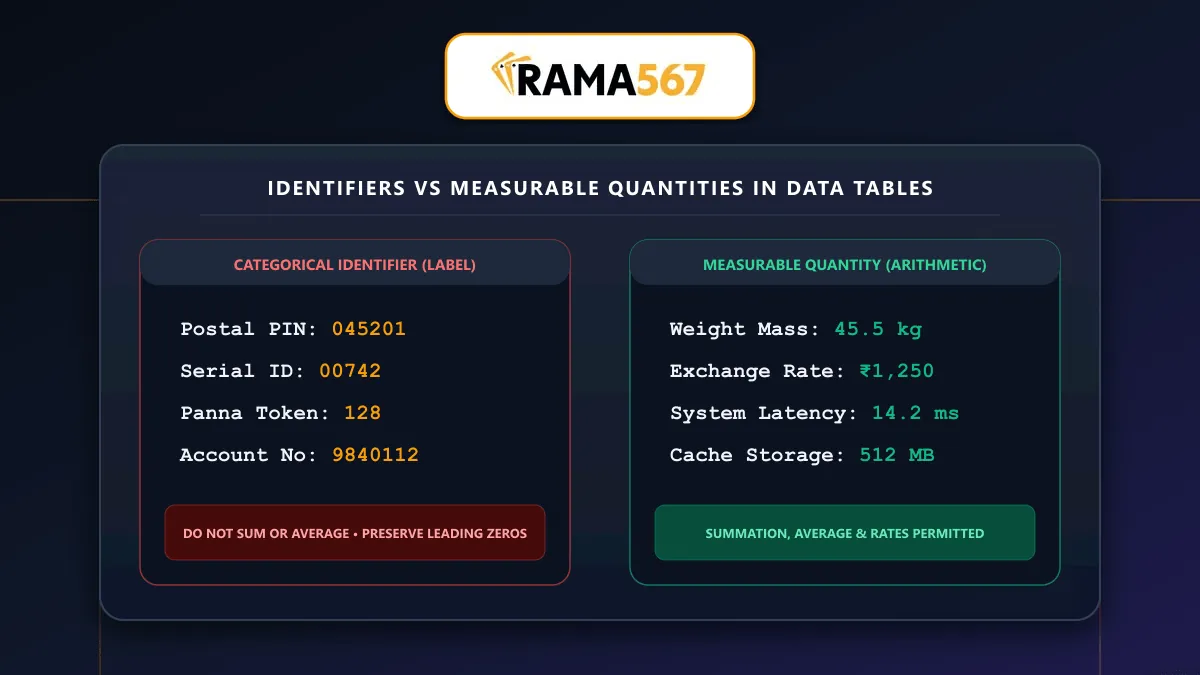
In elementary school mathematics, we are taught that numbers exist to be calculated. If you see two numbers, you can add them, divide them, find their difference, or calculate their average.
In software engineering, database design, and modern data literacy, however, that assumption is a dangerous fallacy.
Just because a data point is written using the digits 0 through 9 does not mean it is a mathematical quantity. Many of the most critical numbers you encounter every day are actually categorical identifiers—symbols wearing the disguise of digits.
Levels of Measurement: Nominal vs. Ratio Data
To understand why calculating certain numbers produces nonsense, we must revisit the four levels of measurement first formulated by psychologist and statistician S. S. Stevens in 1946:
| Level of Measurement | Core Meaning | Can You Compare Order? | Can You Add or Subtract? | Real-World Examples |
|---|---|---|---|---|
| Nominal (Identifiers) | Pure classification & labeling | ❌ No | ❌ No | Postal PIN codes, flight numbers, passport IDs, phone numbers |
| Ordinal | Relative rank or ranking | ✅ Yes | ❌ No | Customer satisfaction (1–5 stars), race finish positions (1st, 2nd) |
| Interval | Measured scale without true zero | ✅ Yes | ✅ Yes (Differences only) | Temperature in Celsius/Fahrenheit, calendar years |
| Ratio (Quantities) | Absolute magnitude with true zero | ✅ Yes | ✅ Yes (Full arithmetic) | Currency amounts, latency in milliseconds, weight in kg, file size |
When a number belongs to the Nominal tier, arithmetic operations are mathematically invalid.
Calculating the "average postal PIN code" of Mumbai (400001) and Delhi (110001) yields 255001—a coordinate in an entirely different state that has no meaningful analytical relationship to either city.
The Leading Zero Disaster: How Spreadsheets Mutilate Data
One of the most persistent operational bugs in enterprise data management stems from treating identifiers as integers.
Consider a five-digit product barcode or an Indian regional postal code that begins with zero: $\text{Original Token: } \mathbf{"045201"}$
When a user imports this record into spreadsheet software or an unconfigured database table:
- The parser examines the characters
0,4,5,2,0,1. - It automatically infers the data type as a 32-bit signed integer (
INT). - Mathematical rules state that leading zeros in integers carry no value: $045201 = 45201$.
- The system silently drops the zero and saves
45201.
The moment that zero is discarded, the token loses its fixed-width validity. An automated postal sorter rejects the barcode, or an API call searching for key 045201 returns a 404 Not Found error.
Engineering Rule of Thumb:
If you will never perform addition, subtraction, or multiplication on a field, never store it as an integer or float. Always store identifiers as a string (VARCHAR/TEXT).
Mathematical Illusions: When Numbers Pretend to Be Strategies
Treating identifiers as calculable quantities is not merely a database problem; it is the root cause of widespread cognitive biases in financial and gaming analysis.
When people look at historical ledgers—such as lottery draws, roulette wheels, or regional market charts—they frequently perform complex arithmetic on drawn numbers:
- Calculating the "average winning digit" over the last thirty days.
- Adding the digits of yesterday's outcome to "predict" tomorrow's number.
- Plotting moving averages of serial draw codes.
These calculations produce elaborate charts, but mathematically, they are completely meaningless.
If a drawn ball is labelled 7, that 7 is not seven kilograms of wheat or a seven-rupee coin. It is simply a distinguishing symbol. If the balls were labelled with letters of the alphabet (A, B, C, D) or colors (Red, Blue, Green), nobody would attempt to calculate the "average of Red and Blue."
As soon as digits are used as symbols, our brains fall into the trap of assuming arithmetic significance where none exists.
Examining Identifiers on Rama567
On Rama567, users navigate extensive historical archives across the charts catalog and read operational rules on the how-to-play page.
In auditing how data is structured in our codebase:
- In daily results, figures appear as three-digit panel combinations (e.g.,
128,359,670) and two-digit jodi pairs (e.g.,45,82). - Each combination represents a discrete combinatorial token and historical outcome index.
- They are not quantities that should be averaged, summed together, or analyzed using standard deviation formulas.
- Storing and displaying them with their exact character width (including leading zeros, such as
079or05) preserves historical accuracy and prevents automated truncation.
Understanding this distinction helps readers appreciate that historical charts serve as structured descriptive archives of recorded events, rather than mathematical equations waiting to be solved.
Summary Checklist for Evaluating Data Fields
Before writing a script or evaluating an online dataset, apply this simple verification test:
- The Meaningful Math Test: Does adding two of these values together produce a sensible new measurement? (If adding two IDs makes no sense, it is an identifier).
- The Leading Zero Test: Does the value have a fixed width where a leading zero is significant? If yes, enforce string formatting.
- The Unit Test: Does the value have an associated physical or currency unit? If not, investigate whether it is a categorical label.
- The Schema Definition: Ensure backend databases store IDs as
VARCHAR, preventing silent auto-conversion errors.
Explore our full series of technical explainers on the Rama567 Blog to deepen your data literacy and learn how digital archives, data provenance, and web architectures function behind the scenes.