
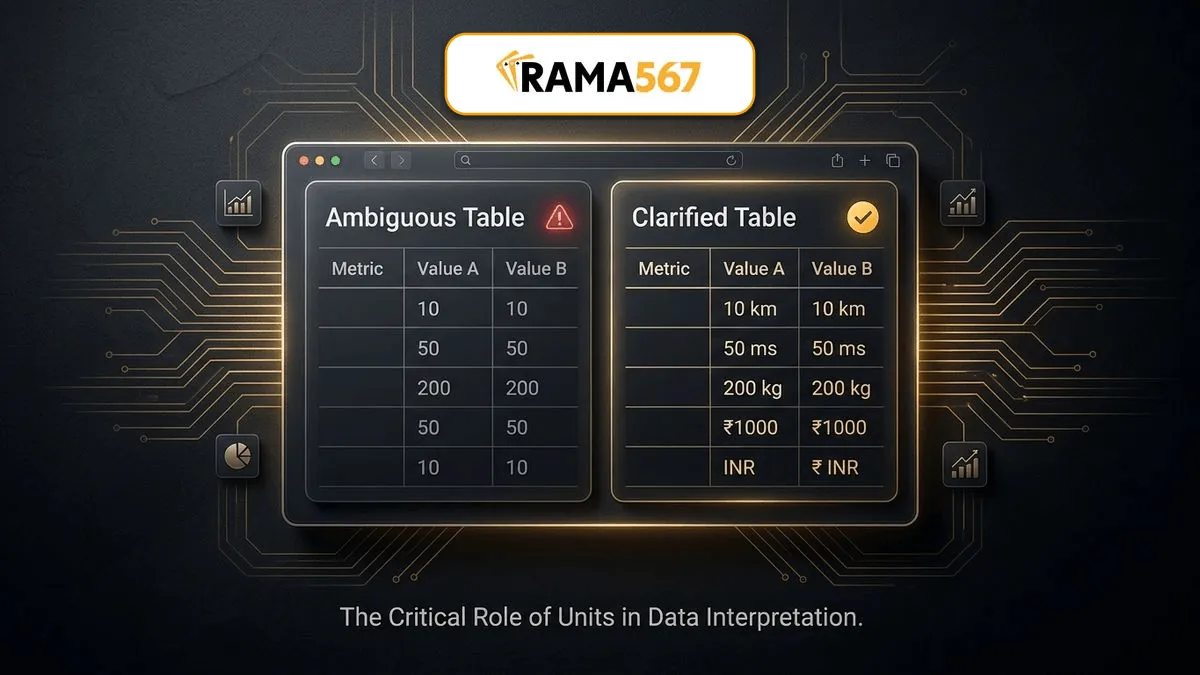
Imagine opening a technical report and reading a column titled “Cost” with the entry “450”. Or viewing a travel dashboard showing “Distance” listed as “120”. Or checking a server latency log that records “Response Time: 0.8”.
What do these values actually mean?
Is the cost 450 Indian Rupees (₹), 450 US Dollars ($), or 450 Euros (€)? Is the distance 120 miles or 120 kilometers? Is the response time 0.8 milliseconds or 0.8 seconds?
A raw number without a declared unit is not factual information—it is merely an uncalibrated integer. In digital data design and analytical research, the unit of measurement is not an optional decorative accessory; it is half of the data point itself.
The Ambiguity of the “Naked” Number
In computational linguistics and dimensional analysis, quantities are comprised of two inseparable components:
$\text{Data Point} = \text{Scalar Magnitude} \times \text{Dimension/Unit}$
When table creators omit the unit, they force the reader to guess based on assumptions. Consider how drastically meaning changes across different dimensions for the exact same numerical scalar:
| Scalar Value | If Interpreted in Currency | If Interpreted in Distance | If Interpreted in Network Time | If Interpreted in Mass |
|---|---|---|---|---|
| 10 | ₹10 (Standard denomination) | 10 meters (A short room) | 10 ms (High-speed ping) | 10 grams (A light envelope) |
| 10 | $10 (~₹840) | 10 kilometers (A distance run) | 10 seconds (A severe server freeze) | 10 kilograms (A heavy suitcase) |
| 10 | €10 (~₹910) | 10 miles (~16 km) | 10 minutes (An offline outage) | 10 metric tons (An industrial truck) |
If you were making logistical decisions, budgeting funds, or configuring server architectures, confusing any of these rows would result in catastrophic miscalculation.
When Missing Units Caused Historical Disasters
The assumption that "everyone knows what unit is being used" has produced some of the costliest engineering failures in human history.
The most famous modern demonstration occurred in September 1999 with NASA’s Mars Climate Orbiter. The spacecraft traveled through interplanetary space for nine months, only to burn up in the Martian atmosphere.
The subsequent investigation revealed that software developed by Lockheed Martin produced thruster output data measured in imperial pound-force seconds (lbf·s). Meanwhile, NASA’s navigation software at the Jet Propulsion Laboratory read those figures into its trajectory models assuming metric newton-seconds (N·s).
Because the data tables exchanged between the software components omitted explicit unit metadata, one pound-force (4.45 newtons) was treated as one newton. That single missing unit destroyed a $125 million mission.
Scale Multipliers: The Invisible Zero Trap
Beyond missing basic measurement units (such as grams, seconds, or rupees), another frequent source of error in online datasets is the omitted or buried scale multiplier.
Publishers frequently format tables to save horizontal screen real estate on mobile devices. To avoid printing rows of long strings with numerous zeros, they write:
“All financial figures expressed in thousands (₹ in ’000s)”
or
“Population in Lakhs (1 Lakh = 100,000)”
If a reader skims the table on a small mobile screen and misses the top subtitle, a figure listed as 50 is read as fifty, when it actually represents fifty thousand (50,000) or fifty lakh (5,000,000).
┌────────────────────────────────────────────────────────┐
│  INCOMPLETE TABLE HEADER:                              │
│  City          | Recorded Volume                       │
│  ──────────────────────────────────────────            │
│  Mumbai        | 450                                   │
│  (Is this 450 units, 450,000 units, or ₹450 Crores?)   │
├────────────────────────────────────────────────────────┤
│  PROPERLY SPECIFIED HEADER:                            │
│  City          | Recorded Volume (Metric Tons, '000s)  │
│  ──────────────────────────────────────────            │
│  Mumbai        | 450                                   │
│  (Explicitly means 450,000 Metric Tons)                │
└────────────────────────────────────────────────────────┘
When comparing two datasets from different websites, always check whether both tables use identical scaling. Comparing an unscaled raw count against a table scaled in thousands creates an erroneous 1000× analytical distortion.
Evaluating Numerical Tables on Rama567
On Rama567, users encounter a variety of numerical presentations, ranging from game rules and rate structures to historical archive grids on the charts page.
In our codebase audit, we observe how numerical designations must be interpreted strictly within their operational context:
- In game-rate documentation, formulas express proportional ratios (for example,
1 RS KA 9.5 Rsor1 RS KA 95 Rs). The explicit inclusion of the currency unit (RS/Rs) clarifies that the value represents an exchange payout multiplier rather than a raw percentage or an arbitrary score. - In historical panel charts, figures appear as three-digit strings (such as
128or456) and two-digit jodi pairs. Here, the values represent fixed-length numerical identifiers and drawn combinations, not quantities that should be measured in units of mass, volume, or currency.
Understanding the difference between an identifier code and a quantifiable physical unit is critical. You would never attempt to add 5 kilograms to a phone number or multiply a calendar date by rupees; similarly, reading table headers with precision prevents conceptual confusion.
Best Practices for Reading and Publishing Data Tables
Whether you are publishing tables on an informational blog or evaluating reference records online, follow these four foundational rules:
- Units Belong in the Header: Place the unit in parentheses inside the column or row label (e.g.,
Revenue (INR Crore),Latency (ms)). Never make readers search through footnotes to discover basic dimensions. - Standardize Measurement Systems: Do not mix imperial units (miles, pounds) and metric units (kilometers, kilograms) in the same comparison table unless a separate conversion column is provided.
- Explicitly Label Currency: Never use a generic
$sign without specifying whether it denotes USD, CAD, or AUD. Where Indian Rupees are referenced, use the official₹symbol orINRcode. - Never Strip Leading Zeros from Codes: If a table contains fixed-width code strings (such as postal codes or panel chart combinations like
079), treat them as formatted text strings rather than standard integers.
Explore our other technical literacy articles on the Rama567 Blog to master how data tables, digital archives, and numerical records are built and validated across the web.