
Table of Contents
- Introduction: The Prestige and Heritage of the Rajdhani Markets
- Exact Market Timetable and Operational Schedule
- Mathematical Anatomy of a Rajdhani Result
- Mastering the Rajdhani Day Chart and Rajdhani Night Chart
- Betting Formats and Verified Payout Multipliers on Rama567
- The Rama567 Real-Time Gaming Engine
- Strategic Risk Management for Rajdhani Enthusiasts
- Frequently Asked Questions (FAQ)
- Conclusion and Action Plan
Introduction: The Prestige and Heritage of the Rajdhani Markets
Among the diverse spectrum of traditional Indian number games, the Rajdhani pairing—comprising Rajdhani Day and Rajdhani Night—holds a distinct, prestigious position. Named after the historic passenger express trains and commercial trade corridors connecting India’s capital to major industrial hubs, the Rajdhani bazars have symbolized speed, punctuality, and deep market liquidity for decades.
Historically emerging from the bustling cotton trade networks in Mumbai and Ahmedabad, Rajdhani established a structured two-session daily cycle that complements foundational markets like Kalyan and Milan. While Kalyan anchors mid-afternoon trading, Rajdhani provides a strategic bridge:
- Rajdhani Day: Captures afternoon trading momentum right before the close of banking hours.
- Rajdhani Night: Represents the premier high-volume late-evening market, drawing analytical players who evaluate day-to-night trendlines and close their daily gaming portfolios.
For players seeking to navigate these markets with precision, guessing numbers at random is a recipe for rapid bankroll depletion. Mastering the Rajdhani ecosystem requires an understanding of exact draw schedules, the mathematical relationship between 3-digit panels and 2-digit brackets, and the interpretation of historical ledgers such as the Rajdhani Night Jodi Chart and Rajdhani Panel Chart.
In this authoritative market deep dive, we break down the operational mechanics of Rajdhani Day and Night, explore how outcomes are mathematically calculated, detail the payout structures available on Rama567, and outline risk management principles to keep your play disciplined and sustainable.
Exact Market Timetable and Operational Schedule
Punctuality is the cornerstone of the Rajdhani markets. A delay of merely thirty seconds in placing a wager can mean missing a lucrative entry window. Both Rajdhani Day and Rajdhani Night follow a strict timetable governed by automated schedule triggers.
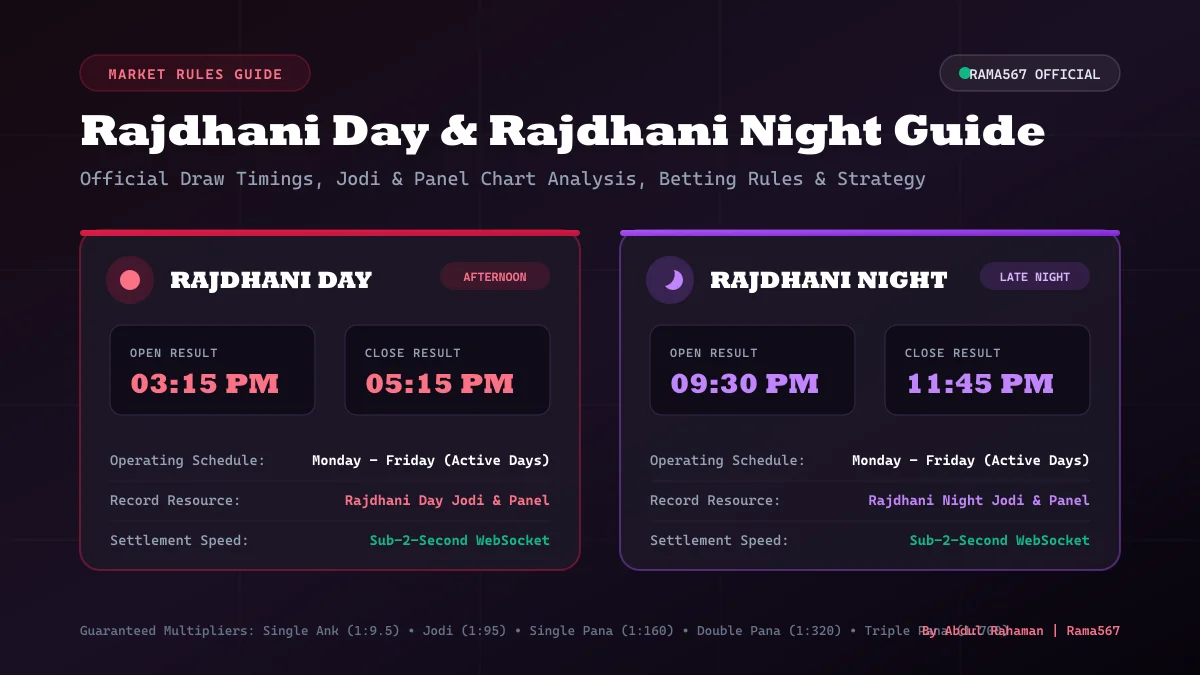
| Market Name | Open Draw Time (IST) | Close Draw Time (IST) | Active Days |
|---|---|---|---|
| RAJDHANI DAY | 03:15 PM | 05:15 PM | Monday – Friday |
| RAJDHANI NIGHT | 09:30 PM | 11:45 PM | Monday – Friday |
Note: Depending on regional festival holidays and specific session calendars, active operational days generally run Monday through Friday, with select special holiday weekend sessions.
Rajdhani Day Draw Timings
Operating across the prime afternoon window, Rajdhani Day unfolds in two synchronized phases:
- Open Session (03:15 PM IST): The opening three-digit panel (Open Pana) is declared. Its digits are summed to establish the Open Single Ank.
- Intermediate Trading Window (03:15 PM – 05:00 PM IST): Players analyze the confirmed Open Ank and place targeted wagers on the Close Single Ank, Close Pana, or Half Sangam combinations.
- Close Session (05:15 PM IST): The closing three-digit panel (Close Pana) is announced, concluding the session and synthesizing the complete two-digit Jodi.
Rajdhani Night Draw Timings
Rajdhani Night commands immense liquidity as the flagship late-evening market:
- Open Session (09:30 PM IST): The evening draw begins promptly at half-past nine, declaring the Open Pana and setting the initial half of the night’s result.
- Close Session (11:45 PM IST): At a quarter to midnight, the final Close Pana is declared, locking in the official closing digit and settling all active tickets.
NTP Server Synchronization and Pre-Draw Cut-Offs
In legacy physical betting setups, local bookmakers often manipulated cut-off times arbitrarily. On Rama567, market clocks are synchronized with atomic precision using high-precision Network Time Protocol (NTP) servers:
- Open Bidding Cut-Off: Automatically locks 10 to 15 minutes before 03:15 PM (Day) and 09:30 PM (Night).
- Close Bidding Cut-Off: Automatically locks 10 to 15 minutes before 05:15 PM (Day) and 11:45 PM (Night).
- Any ticket submitted after the synchronized timestamp is rejected with an instantaneous server message, preventing disputed entries or ambiguous game states.
Mathematical Anatomy of a Rajdhani Result
Every official Rajdhani outcome follows a structured mathematical syntax consisting of an Open Pana, an Open Single Ank, a Close Single Ank, and a Close Pana:
          [Open Pana]        [Jodi]        [Close Pana]
             2 4 7      -    3   8    -       1 8 9
                             ▲   ▲
                             │   └────── Close Ank (1 + 8 + 9 = 18 -> 8)
                             └────────── Open Ank (2 + 4 + 7 = 13 -> 3)
The Three-Digit Panel Derivation
A Panna (or Patti) consists of three numbers drawn from the range $0$ through $9$. Under official Matka rules, the digits must always be sorted in ascending order ($d_1 \le d_2 \le d_3$). In this sequence, 0 represents 10 and is positioned as the highest value.
For example, if the physical draw tokens are 7, 2, and 4, the system strictly normalizes them to:
$\mathbf{247}$
Single Ank Extraction (Modulo 10)
To derive the Single Ank from the panel:
- Sum the three digits of the panel: $\text{Sum} = 2 + 4 + 7 = 13$
- Extract the units digit (modulo 10): $\text{Units Digit} = 13 \pmod{10} = \mathbf{3}$ The resulting digit, $3$, is the official Open Single Ank.
Synthesizing the Final Jodi Bracket
Two hours later, the identical protocol is repeated for the Close draw:
- Closing Panel:
1,8,9(Already in ascending order:189). - Sum: $1 + 8 + 9 = 18$.
- Units Digit: $18 \pmod{10} = \mathbf{8}$ (Close Single Ank).
- Joining the Open Ank ($3$) with the Close Ank ($8$) creates the official Jodi: $38$.
- The complete entry documented in the Rajdhani Night Panel Chart is: $\mathbf{247 - 38 - 189}$
Mastering the Rajdhani Day Chart and Rajdhani Night Chart
Consistent market navigation requires moving away from guesswork and adopting rigorous historical chart evaluation. On Rama567, users have immediate, searchable access to complete historical ledgers through our dedicated Live Matka Charts directory.
Navigating Jodi Record Charts
A Jodi chart catalogs the daily two-digit combinations across weeks, organized from Monday through Friday in vertical columns.
When analyzing the Rajdhani Day Jodi Chart or Rajdhani Night Jodi Chart, analytical players look for:
- Vertical Repetition (Columnar Trends): Instances where an ank appearing on a specific weekday (e.g., Wednesday Open) recurs across consecutive weeks.
- Cross-Diagonal Sequences: Number paths where a Jodi sum from Rajdhani Day mirrors or transfers into Rajdhani Night within a 48-hour cycle.
- Red Jodis (Half-Red and Full-Red Combinations): Pairs comprising identical numbers (e.g., $11, 22, 33$) or cut pairs (e.g., $16, 27, 38, 49, 50$). These indicate specific volatility states where market balances reset.
Sample Weekly Rajdhani Night Historical Matrix:
| Week Comm | Mon | Tue | Wed | Thu | Fri |
|---|---|---|---|---|---|
| Wk 40 | 48 | 29 | 73 | 15 | 90 |
| Wk 41 | 43 | 74 | 28 | 60 | 95 |
| Wk 42 | 98 | 24 | 78 | 10 | 45 |
| Wk 43 | 38 (R) | 67 | 19 | 82 | 54 |
Interpreting the Rajdhani Panel Chart
While Jodi charts only display the two-digit core, the Rajdhani Night Panel Chart and Rajdhani Day Panel Chart document the full three-digit opening and closing combinations ($247-38-189$).
Because there are only 220 possible valid pana combinations in matka (120 Single Panas, 90 Double Panas, and 10 Triple Panas), tracking panel frequency reveals critical distribution patterns:
- Single Pana (SP) Frequency: Represents approximately 54.55% of all historical draws (three distinct ascending digits like
128or359). - Double Pana (DP) Frequency: Represents 40.91% of all draws (two identical digits like
225or448). - Triple Pana (TP) Frequency: Represents 4.54% of draws (all three digits identical, such as
777or000).
For a deep mathematical dive into all 220 combinations, review our dedicated guide on Decoding SP, DP, and TP Panna.
Technical Chart Indicators: Cut Anks, Family Brackets & Red Jodis
Veteran Rajdhani analysts utilize three foundational mathematical concepts:
-
Cut Anks (Opposite Digits): Every digit from $0$ to $9$ has a complementary counterpart separated by five units:
- $0 \leftrightarrow 5$
- $1 \leftrightarrow 6$
- $2 \leftrightarrow 7$
- $3 \leftrightarrow 8$
- $4 \leftrightarrow 9$ If a Rajdhani Day open result declares $3$, chart analysts will monitor whether the close result or the subsequent Rajdhani Night session introduces its cut counterpart ($8$).
-
Family Jodis (Family of 8): A single Jodi shares a mathematical family with seven other combinations formed by swapping one or both digits with their cut counterparts. For instance, the family of Jodi $38$ (which is already a Cut Pair or Red Jodi) includes: ${38, 83, 33, 88}$ For a non-cut Jodi like $14$, its family comprises 8 unique brackets: ${14, 19, 64, 69, 41, 91, 46, 96}$ Statistical cluster analysis frequently demonstrates that when a particular pattern forms in Rajdhani Day, results frequently oscillate within that Jodi's broader eight-member family during the evening session.
Betting Formats and Verified Payout Multipliers on Rama567
Rama567 offers one of the most competitive, transparent, and prompt payout structures across the digital matka landscape. Every format is backed by verified mathematical ratios with zero hidden commission deductions.
Comprehensive Payout Matrix
| Bet Type | Gameplay Selection | Winning Example | Rama567 Payout Rate |
|---|---|---|---|
| Single Ank | 1 Digit (0 to 9) | ₹100 wagered | ₹950 (1 : 9.5) |
| Jodi | 2 Digits (00 to 99) | ₹100 wagered | ₹9,500 (1 : 95) |
| Single Pana (SP) | 3 Unique Digits | ₹100 wagered | ₹16,000 (1 : 160) |
| Double Pana (DP) | 2 Repeated Digits | ₹100 wagered | ₹32,000 (1 : 320) |
| Triple Pana (TP) | 3 Identical Digits | ₹100 wagered | ₹70,000 (1 : 700) |
| Half Sangam | 1 Pana + 1 Ank | ₹100 wagered | ₹100,000 (1 : 1000) |
| Full Sangam | Open Pana + Close Pana | ₹100 wagered | ₹1,000,000 (1:10000) |
For comprehensive rule definitions and visual payout walkthroughs, refer to our official How to Play Guide.
Low vs. High Volatility Selections
Choosing your game format should align directly with your risk tolerance and bankroll size:
- Low Volatility (Single Ank): 1 in 10 base probability ($10%$). Ideal for conservative compounding and foundational capital defense.
- Medium Volatility (Jodi): 1 in 100 probability ($1%$). Leveraged by analysts targeting high-probability family clusters based on Rajdhani Day Jodi Charts.
- High Volatility (Pana & Sangam): 1 in 220 for Pana, up to 1 in 48,400 for Full Sangam. Requires strict stake sizing to account for longer distribution cycles.
The Rama567 Real-Time Gaming Engine
Placing a bid on Rajdhani Day or Rajdhani Night through Rama567 leverages an enterprise-grade technological stack engineered for speed, security, and absolute fairness.
       [User Submits Ticket] (e.g., ₹50 on Rajdhani Night Jodi 38)
                 │
                 ▼
       [Cryptographic Ingestion] (Wallet debited, digital slip hashed)
                 │
                 ▼
       [Clock Hits 09:30 PM / 11:45 PM] (Atomic NTP sync)
                 │
                 ▼
       [Sub-Second WebSocket Feed] (Results broadcasted with <500ms latency)
                 │
                 ▼
       [Automated Backend Settlement] (Winnings credited to balance in <2 secs)
                 │
                 ▼
       [Instant UPI Withdrawal] (Funds transferred directly to your bank)
Sub-Second WebSocket Result Broadcasting
Legacy result portals rely on manual web page refreshes, often causing server crashes or 15-minute delays during peak draw windows. Rama567 replaces legacy HTTP polling with an ultra-low-latency bidirectional WebSocket pipeline:
- Results are published the millisecond the official draw occurs.
- The user interface updates dynamically with zero screen flickering.
- Saves up to 65% mobile data and 40% battery consumption compared to auto-reloading web pages.
Cryptographic Slip Validation & Automated Settlements
Every wager placed on Rama567 receives an immutable transaction hash. Once confirmed:
- Your ticket cannot be altered, canceled, or disputed by local agents.
- The moment the Close draw concludes at 05:15 PM or 11:45 PM, our backend settlement engine evaluates all winning tickets across the database.
- Winnings are automatically credited to your platform balance within two seconds.
Native Android Mobile Experience
For maximum convenience on the go, download the dedicated Rama567 Android APK. The native client provides:
- Instant lock-screen push notifications for Rajdhani Day and Night results.
- Pre-draw countdown alerts so you never miss an Open or Close deadline.
- Biometric authentication and encrypted one-tap UPI deposit and withdrawal requests.
Strategic Risk Management for Rajdhani Enthusiasts
Even the most thorough chart analysis cannot eliminate the inherent variance of numerical gaming. Professional participants adhere to strict risk management protocols to protect capital:
- The 2% Session Exposure Rule: Never commit more than 1% to 2% of your active liquid bankroll to a single Rajdhani draw. If your bankroll is ₹10,000, your maximum combined wager across Open and Close should not exceed ₹200.
- Day-to-Night Capital Separation: Never chase a lost Rajdhani Day wager by doubling your stake on Rajdhani Night. Treat each session as an independent event with its own dedicated budget.
- Automated Profit Sweeping: Whenever you hit a winning ticket, immediately withdraw 50% to 70% of the net profit to your bank account via instant UPI. Locking profits ensures your gains are safe from impulsive re-wagering.
- Pyramid Staking Architecture: Allocate 70% of your session capital to foundational Single Anks, 20% to balanced Jodis, and only 10% to high-multiplier Panas.
For an exhaustive guide on sustainable play, explore our Top 7 Bankroll Management Tips for Responsible Gaming.
Frequently Asked Questions (FAQ)
What are the exact timings for Rajdhani Day on Rama567?
Rajdhani Day opens at 03:15 PM IST (Open Result) and concludes at 05:15 PM IST (Close Result). Bidding closes approximately 10 to 15 minutes prior to each draw.
What are the exact timings for Rajdhani Night on Rama567?
Rajdhani Night opens at 09:30 PM IST (Open Result) and concludes at 11:45 PM IST (Close Result). It represents the premier late-night market on the platform.
Which days do Rajdhani Day and Rajdhani Night operate?
Both markets operate on an active weekday schedule from Monday through Friday, with select weekend and holiday sessions announced on the live lobby.
Where can I analyze past Rajdhani results?
You can access full historical records directly on Rama567:
- Rajdhani Day Jodi Chart
- Rajdhani Day Panel Chart
- Rajdhani Night Jodi Chart
- Rajdhani Night Panel Chart
What is the payout rate for Rajdhani markets on Rama567?
Rama567 offers industry-leading multipliers: 1:9.5 for Single Ank, 1:95 for Jodi, 1:160 for Single Pana, 1:320 for Double Pana, and 1:700 for Triple Pana, with instantaneous UPI settlements.
How do I install the Rama567 App for Rajdhani live updates?
You can download the official, secure Android application directly from the Rama567 APK Download Page to receive real-time push alerts and place quick biddings.
Conclusion and Action Plan
The dual market schedule of Rajdhani Day and Rajdhani Night offers one of the most organized, liquid, and analytically rewarding experiences in online Matka. By mastering their respective timetables, understanding the modulo-10 derivation of Single Anks from 3-digit panels, and tracking recurring patterns across the Rajdhani Night Jodi Chart and Rajdhani Panel Chart, you can approach the market with strategic clarity.
Ready to experience sub-second live results, guaranteed payouts, and 24/7 instant withdrawals?
- 📊 Examine the Records: Study the Rajdhani Day & Night Charts.
- 📲 Get the Native App: Download the Rama567 Android App for live result notifications.
- 🎯 Join Rama567: Register at Rama567 today and enjoy transparent, real-time gaming.
Disclaimer: Online matka and number gaming involve financial risk and may be habit-forming. This publication is strictly for educational, informational, and analytical purposes. Participants must be 18 years of age or older and comply with all applicable local, state, and national regulations governing real-money gaming in their respective jurisdictions.