
In modern internet debates, few tools are invoked with as much finality as a link to the Wayback Machine or Archive.today.
When someone deletes an embarrassing blog post, alters a terms of service agreement, or changes historical statistics on a corporate website, an investigator triumphantly retrieves an archived snapshot: “Look at the proof from 14 October 2021! It was recorded in the archive!”
Digital web archives are undeniably miraculous cultural and forensic achievements. They preserve petabytes of human knowledge that would otherwise vanish down digital memory holes.
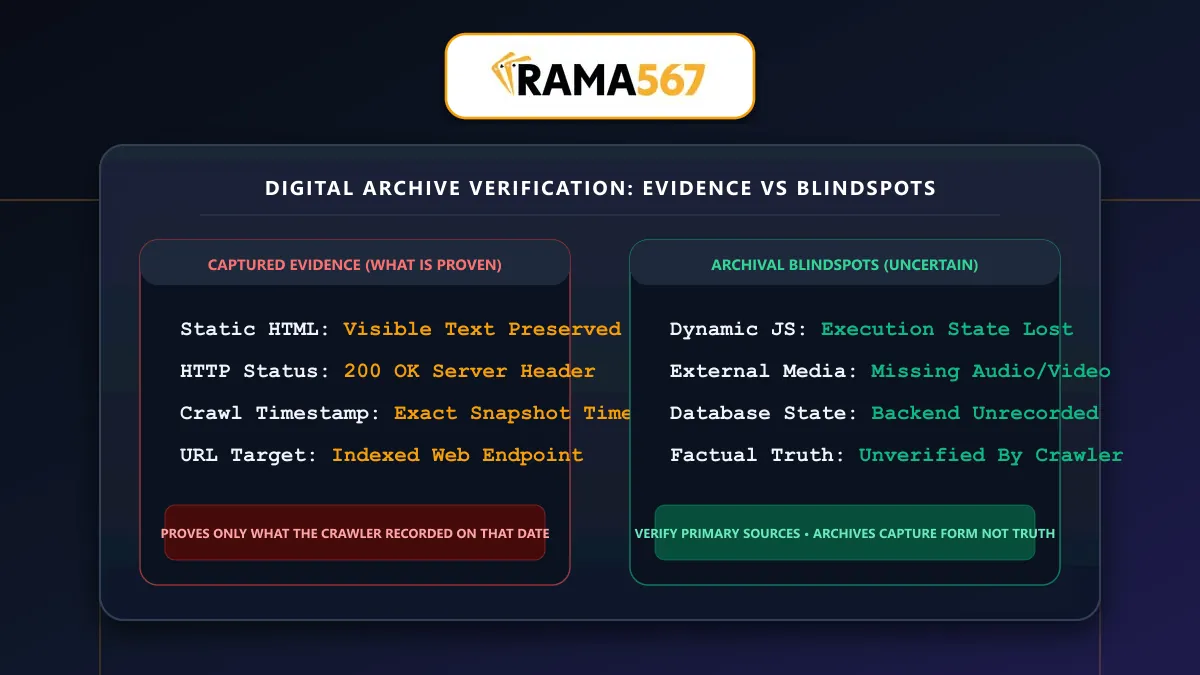
Yet in technical auditing, investigative journalism, and legal discovery, an archived webpage is not an open-and-shut window into reality. Knowing what an archive can prove—and what technical blindspots it leaves behind—is essential for evaluating historical digital evidence.
What a Web Archive Proves with Forensic Certainty
When a reputable public repository like the Internet Archive captures a URL, it creates a standardized file known as a WARC (Web ARChive) file.
That record provides high-confidence proof of four specific technical realities:
┌────────────────────────────────────────────────────────┐
│ WHAT THE WARC ARCHIVAL SNAPSHOT ACTUALLY PROVES:       │
│                                                        │
│ 1. Server Transmission: That a server at that IP       │
│    returned an HTTP response (e.g., 200 OK) to the     │
│    crawler's GET request.                              │
│                                                        │
│ 2. Exact Payload Delivered: That the raw HTML string   │
│    and static headers matched the captured bytes.      │
│                                                        │
│ 3. Temporal Ceiling: That the content existed in that  │
│    state no later than the crawler's UTC timestamp.    │
│                                                        │
│ 4. Public Accessibility: That the page was reachable   │
│    without requiring login credentials or paywalls.    │
└────────────────────────────────────────────────────────┘
If an organization claims: “We never published that policy in 2022,” and a third-party archive holds a snapshot from June 2022 containing that exact HTML paragraph, the archive conclusively refutes their denial.
The Technical Blindspots: What Archives Cannot Prove
Despite their utility, web archives face profound architectural limitations inherent to how the modern web functions.
1. The Client-Side JavaScript Problem (SPAs)
Historically, websites served complete, pre-rendered HTML documents directly from servers. When an archiving crawler downloaded the HTML, it had the full article.
Today, millions of modern web applications—including modern Single Page Applications (SPAs) built with React or Vue—deliver a minimal HTML shell:
<div id="root">Loading application...</div>
The browser then executes client-side JavaScript to fetch data from APIs and render the tables. If the archival crawler’s headless browser times out, fails to execute complex scripts, or is blocked by an API rate-limiter, the archive permanently records a blank white page or an endless loading spinner. The data existed for human visitors, but the archive failed to preserve it.
2. Missing External Assets and CDN Dependencies
Archived pages frequently display broken layouts, missing charts, and broken images. This happens because images were hosted on a separate domain (e.g., cdn.thirdparty.com) that was not crawled simultaneously, or because video players relied on external streaming protocols that crawlers cannot record.
3. Chronological Gaps (The Missing Weeks)
Public web archives do not record websites continuously like a video camera. A popular news homepage might be crawled ten times a day, while a regional data table or informational blog might only be crawled once every six months. If a company published a number on March 1st and quietly edited it on March 4th, an archive that only crawled the site on January 15th and May 20th will never record the edit.
4. Form vs. Factual Truth
The most critical intellectual limitation is this:
The Archival Golden Rule:
An archive proves what was published; it never proves what was true.
If a disreputable website published a fabricated historical chart or an unverified claim in 2019, archiving that page simply immortalizes the fabrication. An archived falsehood is still a falsehood.
Digital Archives and Historical Data on Rama567
On Rama567, users access comprehensive historical charts spanning years of numerical records across our charts catalog.
In evaluating historical records:
- Our static architecture (SSG) compiles historical results into deterministic HTML tables, ensuring that automated search engine crawlers and web archives can preserve our informational records cleanly without script-rendering failures.
- However, in accordance with strict data-literacy standards, readers should recognize that historical chart compilations represent customary reference records of regional markets, rather than statutory legal affidavits.
- An archived snapshot of a 2024 chart verifies that Rama567 displayed those figures on that date; it does not replace the need for critical evaluation and cross-referencing against multiple independent historical archives.
A Reader’s Five-Step Protocol for Evaluating Archived Pages
Whenever you rely on an archived web page as evidence in research, follow this validation protocol:
- Inspect the Archival URL Bar: Notice the timestamp embedded in the Wayback URL (e.g.,
web.archive.org/web/20261014120000/https://...). That string reveals the exact year, month, day, and second of the crawl. - Check for Redirection Bounces: Confirm that the crawler was not redirected to a parked domain, a 404 error page, or a regional geo-block during the snapshot.
- Inspect the Raw Page Source: Right-click the archived page and choose View Page Source. Search for the actual text strings inside the HTML to ensure they were not dynamically injected by modern crawler wrappers.
- Compare Multiple Archive Providers: If a snapshot on Wayback Machine is incomplete, cross-reference alternative independent services like Archive.today or national library web archives.
- Separate Attribution from Proof: Always ask: Who published this originally, what was their source, and can this claim be corroborated outside the browser?
Continue expanding your digital literacy by reading our related guides on website version history and data provenance on the Rama567 Blog.